
Its Tempting...

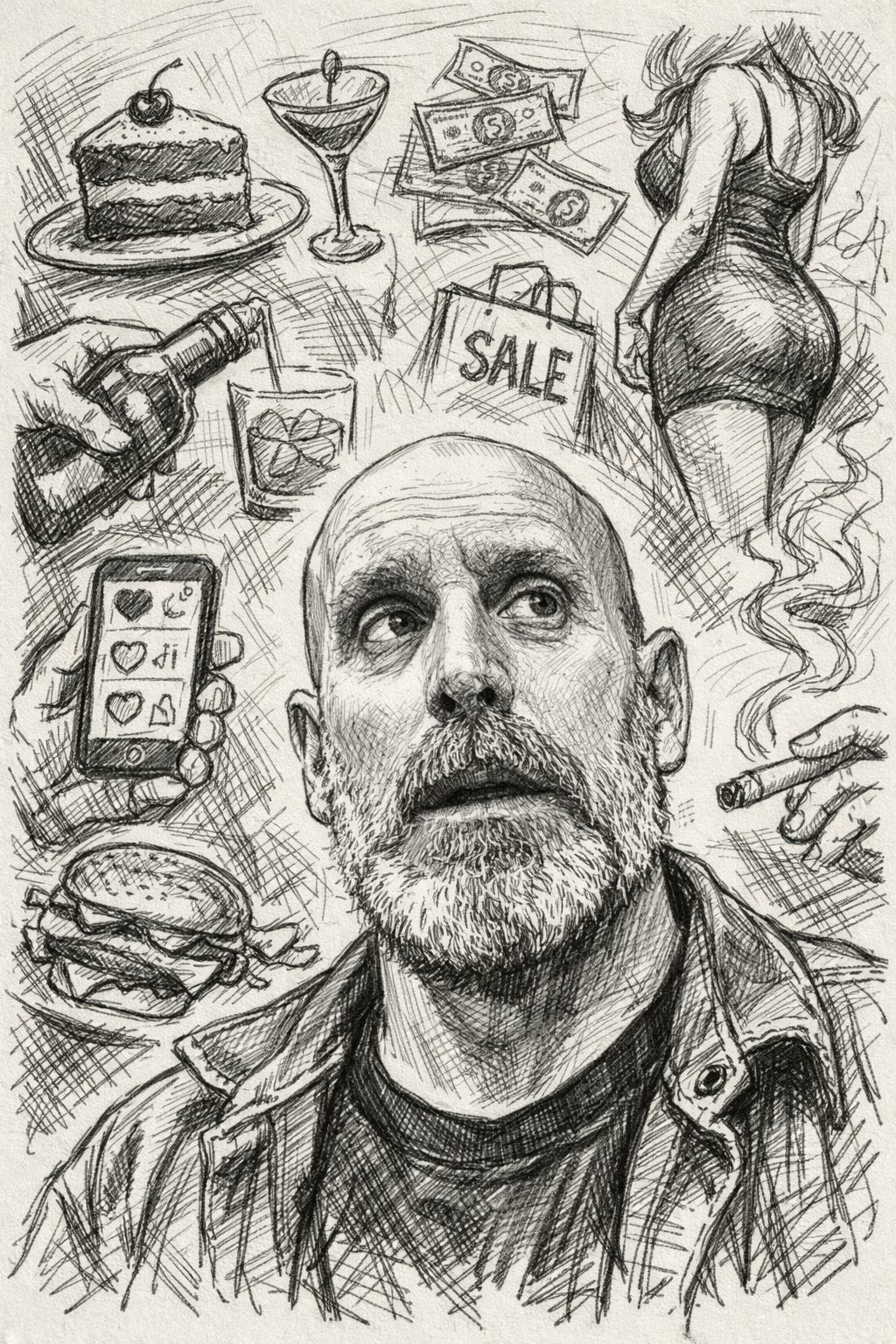
Here’s something that should bother you.
If you are tempted and resist, people see you as less virtuous than someone who was never tempted at all.
Even if you do the right thing.
Sit with that for a second...
We love the myth of the unshaken human. The person who says, “It never even crossed my mind.” Clean. Untouched. Stainless.
But the one who says, “I wanted to, but I didn’t” quietly loses status. Research shows that observers downgrade them simply because temptation existed. The struggle itself becomes evidence. The fact that you felt the pull makes you look morally thinner, even if you overpowered it.
We claim to respect discipline. What we actually worship is effortlessness.
There is something in us that prefers purity over perseverance. We want our heroes to float above desire, not wrestle it in the dirt. The presence of appetite feels like a crack in the foundation – even when the house stands.
It gets stranger.
Imagine two people trying to avoid a bad habit. One installs a blocker app, locks the liquor cabinet, automates savings, uses a commitment contract. The other leaves everything within reach and relies on raw willpower.
The first person is more likely to succeed. The data is clear on that. External guardrails work. Friction works. Design works.
And yet, people consistently judge the first person as less trustworthy. Less strong. Less virtuous.
We romanticize white knuckles. We side eye strategy.
There is a cultural story running underneath all of this. It says real character means facing temptation head on and winning through inner force alone. If you need help, if you restructure your environment, if you make it harder to fail, somehow that counts less.
But here is the uncomfortable truth. The people who look most virtuous may not be fighting harder at all.
Brain imaging research suggests that deeply honest individuals do not experience temptation as intensely in the first place. When presented with the opportunity to cheat for money, their reward centers light up less. There is less internal debate. Less friction. Less fire to extinguish.
They are not necessarily moral gladiators. They might just have different wiring.
Think about what that does to our whole narrative around virtue.
If someone feels little pull toward dishonesty, they look pure without effort. If someone feels a strong pull and resists, they look suspect, even heroic, but somehow stained by the desire itself.
We are judging outcomes through a lens that ignores biology.
And biology does not politely stay in the background.
Consider what psychologists call a hot state. You are hungry. Stressed. Lonely. Tired. Craving. In that state, your reasoning does not operate as an impartial judge. It bends. It becomes a defense attorney for whatever impulse is already in motion.
You tell yourself you are thinking carefully. In reality, you are constructing permission. The story shifts. The risk seems smaller. The reward feels bigger. You find logic that would have embarrassed you an hour earlier.
Trying to outthink a hot state is like trying to negotiate with a storm while standing in it.
Then there is the metabolic piece. Willpower is not just poetic language. It has a cost. Studies have shown that blood sugar levels affect self control. When glucose drops, impulse control drops with it. The body and the moral story are intertwined. You are not a disembodied mind floating above chemistry.
This does not mean we are helpless. It means the battlefield is different than we were told.
We have been trained to see temptation as a character test. A showdown. A moment where you prove who you are by clenching your jaw and choosing correctly.
But if temptation is amplified by stress, fatigue, hunger, loneliness, and certain neural wiring, then the real leverage exists long before the dramatic moment arrives.
Look at everyday life. Late night scrolling. One more drink. One more purchase. One more sharp comment you will regret in the morning. These are not epic moral collapses. They are small erosions.
Most of them happen when you are depleted.
You are not at your best when you are tired and alone with your phone. You are not at your best when you have skipped meals and are making financial decisions. You are not at your best after a long week when everything in you wants relief.
And yet we still tell ourselves that the solution is more grit.
More discipline. More internal lectures. More promises to do better next time.
What if that is the wrong arena?
What if strength is not primarily about resisting temptation but about reducing exposure to it?
Eat before the difficult conversation. Move the phone out of the bedroom. Automate the savings. Delete the app. Leave the credit card at home. Arrange the furniture of your life so that your weakest moments have fewer sharp edges.
This is not cowardice. It is strategic humility.
It is an admission that you are a human organism with limits. That your brain has patterns. That your body has thresholds. That hot states are predictable.
There is something quietly powerful about accepting that you do not need to prove your character in every possible arena. You do not need to demonstrate that you can stand next to the cliff without falling. You can simply step back from the edge.
The paradox is this. We judge people as more virtuous when they appear untempted. We judge them as weaker when they use guardrails. We assume the strongest person is the one who battles hardest.
Reality points somewhere else.
The most stable lives are often built by people who understand their vulnerabilities and design around them. They are not staging moral heroics every night. They are quietly structuring their environment so the fight rarely escalates.
The takeaway is not sentimental.
If you want to live with more integrity, stop obsessing over how strong you are in the moment of temptation. Start paying attention to the conditions that make temptation loud.
Reduce the noise before it starts.
Character is not a dramatic performance under pressure. It is the architecture of your ordinary days.
And the smartest people are not the ones who win the fight every time.
They are the ones who know when not to step into the ring.
Chew the Fat.
Jason