
Write or Wrong?

Fat of the Land
by
Jason A Mankin
There are seasons when writing feels like oxygen. You wake up with sentences already forming. You carry a notebook like it’s a limb. You feel more alive with a pen in your hand than without it.
And then there are seasons like this.
The kind where writing feels like one more obligation on a long list of things that already want too much from you. The kind where the blank page doesn’t feel inviting. It feels accusatory. Like it knows how long it has been since you last showed up honestly.
People like to romanticize writing. They talk about flow and inspiration and losing track of time. They talk about the joy of creation, the thrill of being understood, the quiet magic of putting language around experience.
All of that is real.
So is this.
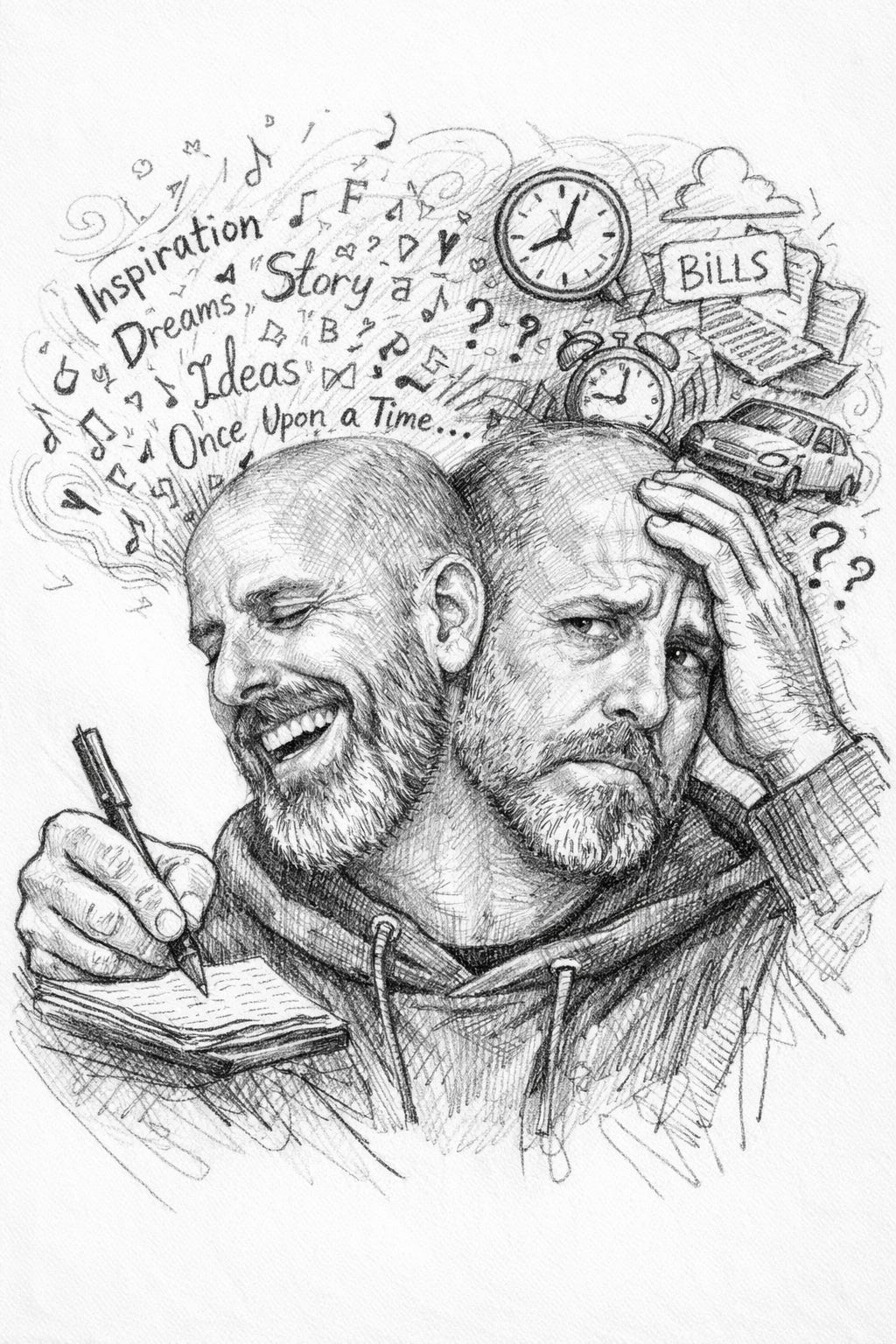
Writing while working full time. Writing while loving someone who needs you. Writing while parenting or studying or rebuilding your life. Writing while paying bills and managing fatigue and holding grief that seems never ending.
Writing when your mind is already tired.
Writing when your body wants rest more than expression.
Writing when pleasure feels irresponsible and art feels indulgent.
That version of writing does not get talked about enough.
Most days, the difficulty is not talent or discipline. It is bandwidth. It is emotional capacity. It is the simple fact that life keeps happening even when you are trying to listen to your inner voice.
Work takes language away from you. Emails drain tone. Meetings flatten thought. By the time you sit down to write, your words feel used up. Like loose change at the bottom of a pocket you have already emptied twice.
Love complicates it further. Real love asks for presence. It wants your attention. It wants you awake. Writing often asks for disappearance. It asks you to go somewhere inward and stay there long enough to find something worth bringing back. Balancing those two pulls can feel like betrayal no matter which one you choose.
Life itself does not wait politely while you finish a paragraph. It interrupts. It intrudes. It asks questions that cannot be postponed. Writing does not happen in a vacuum. It happens in kitchens and cars and late nights after everyone else has gone off to bed.
School turns writing into performance. Grades and expectations slide in where curiosity used to live. You start thinking about what will pass instead of what feels true. Over time, the page learns to scare you.
And money. Writing for money is its own strange pressure. The moment your words become income, they pick up weight. You start wondering whether enjoyment is allowed. You ask yourself if this sentence earns its keep. You hesitate. You second guess. You stop playing.
At some point, the thing that once saved you starts asking to be saved itself.
This is where a lot of writers quietly drift away.
Not because they do not care.
Because caring costs energy they do not have.
Because they are tired of carrying language around like an unpaid debt.
Because writing no longer feels like freedom. It feels like one more place they are falling short.
What makes this especially painful is the memory of how it used to feel.
You remember writing for the sheer pleasure of it. Writing that went nowhere and didn't need to. Writing that didn't explain itself. Writing that didn't need an audience or a purpose or a plan.
You remember when the page felt like a refuge instead of a responsibility.
That contrast can break your heart if you stare at it too long.
So you avoid the page. You tell yourself you will come back when things calm down. You tell yourself this is temporary. You tell yourself real writers push through.
None of those stories help much.
The truth is simpler and harder to accept.
Writing is affected by the same forces that affect everything else in a human life. Stress shrinks it. Exhaustion dulls it. Overload makes it clumsy. Pressure distorts it.
That does not mean you have failed.
It means you are human.
Sometimes the most honest thing a writer can admit is that writing is hard right now. Not forever. Not in principle. Right now.
There is a quiet dignity in that admission.
It creates space for a different kind of relationship with the page. One that does not demand brilliance or productivity or proof. One that allows writing to be small. Fragmented. Incomplete.
Some seasons call for long essays. Others call for a paragraph scribbled in the margin of a day that nearly swallowed you whole.
Some seasons call for publishing. Others call for writing that no one will ever see.
None of those count less.
If writing feels heavy, it might be because you are carrying too much elsewhere. If joy feels distant, it might be because survival is taking priority. That does not make you lazy. It makes you alive.
The page will still be there.
Writing is not always about output. Sometimes it is about staying in relationship with yourself during a season that would rather pull you apart.
If you are struggling to write, you are not broken. You are not alone. You are not behind.
You are living a life that asks a lot.
And if you keep one small door open to language, even on the days it feels like work, that is enough to bring the joy back when the weight finally lifts.
It always does.
Chew the fat.
Jason
"The kind where writing feels like one more obligation on a long list of things that already want too much from you. The kind where the blank page doesn’t feel inviting. It feels accusatory. Like it knows how long it has been since you last showed up honestly."
Yes, so much so. Excellent piece 👏
I really needed to read this. I’m new to writing, and life is so full that if I don’t write at 5am, I don’t write at all. By 8pm, the 'distortion' sets in and my brain is mush. The reminder to just be human is always good practice✨